The UK visitor visa approval rate from India is high: in recent years roughly 8 to 9 out of every 10 Indian visitor applications have been granted (approximate, based on official Home Office statistics). But that average hides a lot. A salaried person with steady savings and a clear 2-week plan is in a very different position from a first-time traveller whose bank balance appeared last week. This guide explains what UK entry clearance officers actually check, the documents that carry the most weight, the latest fees and the mistakes behind most refusals.
What is the real UK visitor visa approval rate from India?
India is one of the largest sources of UK visitor visa applications in the world. Hundreds of thousands of Indians apply every year for tourism, family visits and business meetings, and the large majority are approved.
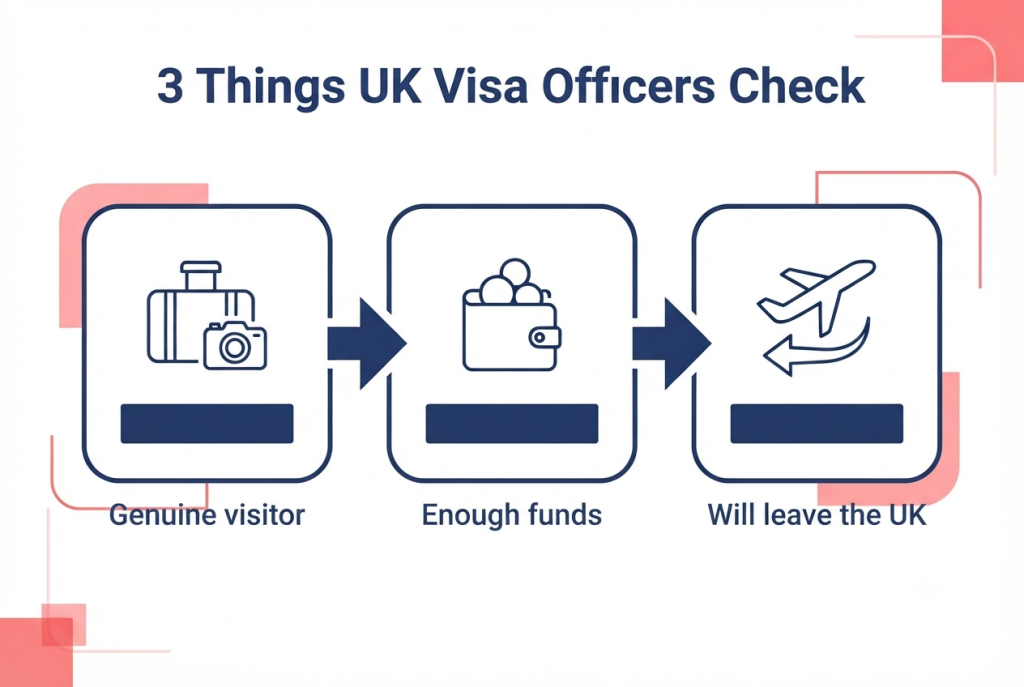
Still, the national figure does not predict your result. The UK decides each application on its own merits. The officer has to be satisfied of three things under the visitor rules:
- You are a genuine visitor — you are coming for a permitted purpose, such as tourism, family or business meetings, and not to work or live.
- You can pay for the trip — without working in the UK or using public funds.
- You will leave at the end of the visit — your life, job and family are in India.
If your documents answer all three clearly, your personal chance is much higher than the average. If one is weak, a refusal becomes likely.
Want an honest estimate for your own profile? Check your UK visa chance in 2 minutes — free, and nothing gets submitted.
What UK visa officers really check
| What they check | Strong evidence | Weak evidence |
|---|---|---|
| Purpose of visit | Clear plan, hotel or host details, event or business invitation | “Tourism” with no plan, very long stay |
| Funds | 6 months of steady bank statements, salary credits | Large deposit just before applying |
| Income source | Salary slips, ITR, employer letter, business proof | Cash income with no records |
| Ties to India | Job with approved leave, business, property, family | No fixed job, recently resigned |
| Travel history | Earlier UK, Schengen, US or other visas used correctly | First trip, or an earlier overstay anywhere |
| Consistency | Same dates and amounts on every paper | Form says one thing, documents say another |
| Honesty | Earlier refusals declared | Refusal hidden — this can lead to a long ban |
The honesty point matters a lot in the UK. If you hide an earlier refusal from any country, or submit a false document, the UK can refuse you for deception and ban you from applying for years. A declared refusal is a small problem. A hidden one is a big one.
Check your visa chancesSee your approval chances in a minute - free assessment.Check now →How much money to show for a UK visitor visa from India
The UK does not set a fixed minimum balance for visitors. The officer checks that the trip cost is reasonable compared with your income and savings.
| Traveller type | Trip length | Comfortable balance to show (approx.) |
|---|---|---|
| Single traveller | 1–2 weeks | ₹3–5 lakh |
| Couple | 1–2 weeks | ₹5–7 lakh |
| Parents visiting children in the UK | 4–8 weeks | Own savings ₹3–5 lakh + child’s support letter, status and bank statements |
| Business visitor | under 2 weeks | Company letter that the company pays |
Approximate guide only, not an official rule. What matters most is that your balance is steady and matches your income.
As with any visa, a balance that suddenly jumps before you apply looks like borrowed money. If you have a genuine large deposit, such as an FD maturity or property sale, attach proof and a short explanation.
UK visitor visa fees and processing time from India (2027)
| Visa type | Approximate Home Office fee |
|---|---|
| Standard Visitor visa (up to 6 months) | £135 |
| Long-term visitor visa, 2 years | £506 |
| Long-term visitor visa, 5 years | £903 |
| Long-term visitor visa, 10 years | £1,128 |
| Visa centre charges, priority service | extra, optional |
| Usual decision time | about 3 weeks after biometrics; priority options can be faster |
Fees from 8 April 2026, approximate. Always confirm on the official GOV.UK Standard Visitor visa page before paying.
Tip: for a first UK trip, apply for the 6-month visa. Long-term visas (2, 5 or 10 years) suit people who visit often and already have a good UK travel history.
For the full document list and process, see our page on the UK tourist visa from India.
How to improve your UK visitor visa chances (step by step)
- Write a clear purpose. Where you will go, how long, where you will stay and who pays.
- Show 6 months of steady bank statements. Plus salary slips and 2–3 years of ITR.
- Prove your ties to India. Approved leave letter, business registration, property, family responsibilities.
- Use your travel history. Attach copies of earlier visas, especially Schengen, US, Canada or Australia.
- Declare everything honestly. Earlier refusals from any country, previous names, relatives in the UK.
- Keep the stay realistic. A 2-week holiday looks natural; 5 months of “tourism” with a job in India does not.
- If family in the UK is hosting you, add their invitation letter, status proof and address.
- Check every date. The form, leave letter, bookings and cover letter must match.
Not sure your file is complete? Make a free personalised list with our Document Checklist Creator.
Common mistakes to avoid
- Hiding an earlier refusal. This is the most dangerous mistake for UK applications.
- Last-minute deposits. Keep funds steady for at least 3–6 months.
- Showing funds that do not match your income. ₹20 lakh savings with a ₹3 lakh ITR raises questions.
- A long trip with weak ties. Officers worry you may work or stay on.
- Sponsor letters with no proof. If someone else pays, add their bank statements, income and relationship proof.
- Paying for non-refundable tickets before the visa.
- Using a template cover letter. Write your own short, honest letter.
UK visitor visa refused? What next
There is usually no right of appeal for a refused visitor visa. Your main option is to reapply with the weak points fixed. Read the refusal letter carefully — it lists each reason the officer was not satisfied. Answer every one with clear evidence, and declare the earlier refusal in your new application. Our Visa Refused? Get Help page explains the options.
Key takeaways
- The UK visitor visa approval rate from India is high — roughly 8 to 9 in 10 recently (approximate) — but your own chance depends on your file.
- Officers check three things: genuine visitor, enough funds, and that you will leave.
- Never hide an earlier refusal — deception can lead to a multi-year ban.
- A comfortable guide is about ₹3–5 lakh single for 1–2 weeks (approximate); steady funds matter more than a big number.
- The 6-month Standard Visitor visa fee is £135 from 8 April 2026 (approximate — verify on GOV.UK).
Frequently asked questions
What is the UK visitor visa approval rate from India?
In recent years roughly 8 to 9 out of 10 Indian visitor visa applications have been granted, based on official Home Office statistics (approximate). Your personal chance depends on your funds, ties to India, travel history and how clear your plan is.
How much bank balance is needed for a UK visitor visa from India?
There is no fixed minimum. As a practical guide, a single traveller often shows about ₹3–5 lakh for a 1–2 week trip and a couple about ₹5–7 lakh (approximate). Steady savings and income that match your ITR matter more than a large balance.
What is the UK visitor visa fee for Indians in 2027?
The Standard Visitor visa for up to 6 months costs £135 from 8 April 2026. Long-term visitor visas cost about £506 for 2 years, £903 for 5 years and £1,128 for 10 years (approximate). Visa centre and priority charges are extra; verify on GOV.UK.
Why are UK visitor visas refused for Indians?
The most common reasons are unclear funds or sudden deposits, weak ties to India, an unrealistic trip length, documents that do not match, and not declaring an earlier refusal. The refusal letter lists the exact reasons, so read it carefully before reapplying.
Can I appeal a UK visitor visa refusal?
Usually there is no right of appeal for a visitor visa refusal. The normal route is to reapply with the weak points fixed and new evidence added, and to declare the earlier refusal honestly. You can check your updated chance on our free visa calculator before you apply again.
Before you book your UK visa appointment, check your visa chance free in 2 minutes →