
Getting a UK visa refusal is stressful, especially when you know you sent the right documents. The refusal letter usually ends with the line that there is no right of appeal and no administrative review. Most people then simply apply again - and some are refused again for the same reason.
There is another route. If the Entry Clearance Officer made a legal mistake - ignored evidence, got the facts wrong, or gave reasons that do not hold up - the decision can be challenged by judicial review. The first step of that challenge is a formal letter called the Pre-Action Protocol (PAP) letter. This guide explains how it works, who it suits, and when a new application is the better choice.
Why most UK visit visa refusals cannot be appealed
A full appeal to the immigration tribunal is only available in a few kinds of cases, mainly human rights and protection claims. Visitor visas (tourism, family visits, business trips) normally have no right of appeal, and administrative review is not offered for them either. That is why the refusal letter says you may reapply.
This does not mean the decision cannot be questioned. UK public bodies, including UK Visas and Immigration (UKVI), must make decisions lawfully, fairly and reasonably. When they do not, the courts can look at the decision through judicial review.
What judicial review is - and what it is not
Judicial review is a check on how a decision was made, not a new decision on your visa. The judge does not ask "Should this person get a visa?" but "Did the officer follow the law, look at all the evidence and give rational reasons?"
- It looks at the evidence the officer had when deciding - not at new documents you add later.
- If the challenge succeeds, the usual result is that the refusal is cancelled and the application is decided again. The court does not issue the visa itself.
- Most visa cases never reach a judge: they are settled at the Pre-Action Protocol stage.
What a Pre-Action Protocol letter is
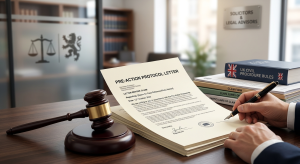
Before a judicial review claim can be filed, the person challenging the decision is expected to write to the decision maker and give it a chance to put things right. This step is set out in the Pre-Action Protocol for Judicial Review. For a UK visa refusal, the letter goes to the Home Office (UKVI).
A well-written PAP letter usually covers:
- Who is challenging - the applicant's name, date of birth, nationality and the GWF / application reference.
- The decision - the date and the type of refusal being challenged.
- The facts - a short, clear account of what was applied for and what was sent.
- The legal errors - point by point, why the decision is unlawful (the "grounds"), linked to the documents and the Immigration Rules.
- What is asked for - usually that the refusal is withdrawn and the application is decided again by a different officer.
- A reply date - normally 14 days.
The time limits you cannot miss
- 3 months: a judicial review claim must be made promptly and in any case within 3 months of the decision. Late claims are rarely allowed.
- 14 days: the Home Office normally replies to a PAP letter within 14 days. Sometimes it asks for more time.
- Plan backwards: the PAP letter, the reply and (if needed) the court claim must all fit inside the 3 months. In practice, send the refusal for review within the first 4 to 6 weeks.
Mistakes that make a strong PAP case
- Evidence ignored: the refusal says something was "not provided" - but it was in your application (for example bank statements, an employer letter or property papers).
- Facts wrong: wrong income, wrong travel history, wrong family details or wrong dates in the refusal letter.
- Rules misapplied: the officer applied a test that is not in the Immigration Rules, or set a higher bar than the rules ask for.
- Irrational reasons: the conclusion does not follow from the evidence - for example doubting your return when you have a long, well-paid job, a family and a clean travel record.
- Unfair process: a concern was held against you without any chance to explain, or an interview note was misread.
- No proper reasons: the letter gives a general paragraph that does not engage with your actual documents.
When a fresh application is the better choice
- A document really was missing or weak - fix it and apply again with a clear cover letter.
- You now have new evidence (a PAP only looks at what the officer had).
- More than 3 months have passed since the refusal.
- The decision was harsh but lawful - you simply disagree with it.
- Your travel date is very close and a quick new application is more practical.
PAP or new application: a quick comparison
- What is checked - PAP: whether the refusal was lawful. New application: your new file from the start.
- New documents - PAP: no, only what you sent. New application: yes.
- Time - PAP: about 14 days for the reply, then a fresh decision. New application: the normal processing time.
- Refusal record - PAP: a withdrawn refusal is no longer a valid decision against you. New application: the earlier refusal stays on your record and must be declared.
- Best for - PAP: clear officer mistakes. New application: weak or incomplete files.
What can happen after the PAP letter
- The Home Office agrees: it withdraws the refusal and reconsiders the application - often without a new visa fee. A fresh decision follows (it can still be a refusal, but now on correct grounds).
- The Home Office refuses to change the decision: the case can go on to a judicial review claim in the Upper Tribunal, or you can choose a fresh application instead.
- No reply in time: the claim can be filed before the 3 months run out.
Costs and risks to know
A PAP letter is the low-cost stage of a challenge. If a case goes on to a court claim, there are court fees and legal costs, and a claimant who loses can be ordered to pay part of the Home Office's costs. That is why every case should be checked honestly at the start: a PAP is worth it when the mistake is clear, not as a way to argue with a fair decision.
While your PAP is pending
- Do not submit a new application without advice - a fresh decision can make the challenge pointless.
- Keep all emails from UKVI and the visa centre.
- Keep your passport and documents ready in case the application is reconsidered and more information is asked for.
Applying from outside India
If you live abroad (for example in the UAE, Europe or the Gulf) and applied for the UK visa from there, the same rules apply. The time limit runs from the refusal date, wherever you are. Send us the refusal from where you live - our team for your region will contact you.
What to send us
- The refusal letter (all pages) and its date.
- Your GWF / application reference number.
- Copies of the documents you submitted, if you have them, and your visa application form.
- A short note on anything the officer got wrong.
We read the refusal, check it against what you sent, and tell you honestly whether a PAP has a real chance or a fresh, stronger application is the better route - and we guide you through the next steps either way.
This guide is general information, not legal advice. Every case depends on its own facts, rules can change, and no result is guaranteed.
Frequently asked questions
Can I appeal a UK visit visa refusal?
What is a Pre-Action Protocol letter?
How long do I have?
How long does the Home Office take to reply?
Can I add new documents to a PAP?
What happens if the Home Office agrees?
Does a withdrawn refusal stay on my record?
Should I apply again while my PAP is pending?
Can I use a PAP if I applied from outside India?
Related articles
 What Is a Pre-Action Protocol Letter? When & Why You Need One
 UK Pre-Action Protocol Explained: A Complete Guide for Visa Applicants (2026)
More visa guides
- Visa Refused? What to Do Next
- How to Write a Cover Letter for a Visa Application (with Samples)
- Travel Itinerary for Visa: How to Make One (with Samples)
- SOP for Student Visa: How to Write (with Structure)
- Schengen Visa Documents Checklist for Indians (2026)
- Study Abroad Intakes: September, January and May by Country





