Your US B1/B2 visa chances from India are decided mostly in a 2–3 minute interview. The officer starts by assuming you might want to stay in the US, and you have to show the opposite: a clear reason to visit and a stable life in India to come back to. Many Indians are approved every year, but a noticeable share are refused under Section 214(b). This guide explains what the officer really looks at, how the interview works, the latest fees and rules, and what actually improves your odds.
How US visa chances really work for Indians
The US visitor visa is different from Schengen or UK visas in one big way: the interview carries most of the weight. Your DS-160 form and documents set the scene, but the officer often decides after a few questions.
Under US law (Section 214(b)), every visitor visa applicant is presumed to be an intending immigrant until they prove otherwise. In simple words, you must convince the officer of three things:
- Your purpose is temporary and genuine — tourism, family visit, business meeting, conference or medical treatment.
- You can pay for the trip — yourself or through a clear sponsor.
- You have strong ties to India — job, business, family, property — that will bring you back.
There is no fixed “approval rate” for you as a person. Two people with the same income can get different results because their stories and answers are different.
Want an honest estimate before you pay the fee? Check your US visa chance in 2 minutes — free, and nothing gets submitted.
What gets Indians approved for a B1/B2 visa
| Factor | Helps your chances | Hurts your chances |
|---|---|---|
| Employment | Stable job, several years with the same employer | No job, recently resigned, frequent job changes |
| Income | Clear salary or business income, ITR filed | Cash income, no ITR |
| Family in India | Spouse, children, parents depending on you here | Single, few responsibilities, close family already in the US |
| Travel history | Earlier Schengen, UK, Canada, Australia, Dubai, Singapore trips | First passport, no travel at all |
| Purpose | Short, specific trip: “2 weeks, New York and Orlando with my wife” | Vague: “I want to see America”, 6 months |
| Previous US history | Earlier visas used correctly | Earlier overstay or status violation |
| Answers | Short, honest, confident, consistent with DS-160 | Memorised, nervous, contradicts the form |
Close family in the US is not a reason for refusal by itself. Parents visiting a child who studies or works in the US are approved all the time. But the officer will look harder at your own ties to India, so make sure they are clear.
Check your visa chancesSee your approval chances in a minute - free assessment.Check now →The US visa interview: what to expect
- Most applicants need an in-person interview. Since September 2025 the interview waiver (“dropbox”) has been sharply limited, so plan for an interview unless you clearly qualify for a renewal waiver.
- Apply in India. Applicants are expected to interview in their country of nationality or residence, so booking in another country is usually no longer a shortcut.
- Wait times can be long. Interview slots at Indian consulates are often booked months ahead. Check the current wait time for your city and apply early.
Common questions you may hear:
- Why do you want to go to the US?
- How long will you stay, and where?
- What do you do for work? How long have you worked there?
- Who is paying for the trip?
- Do you have family in the US? What do they do?
- Have you travelled abroad before?
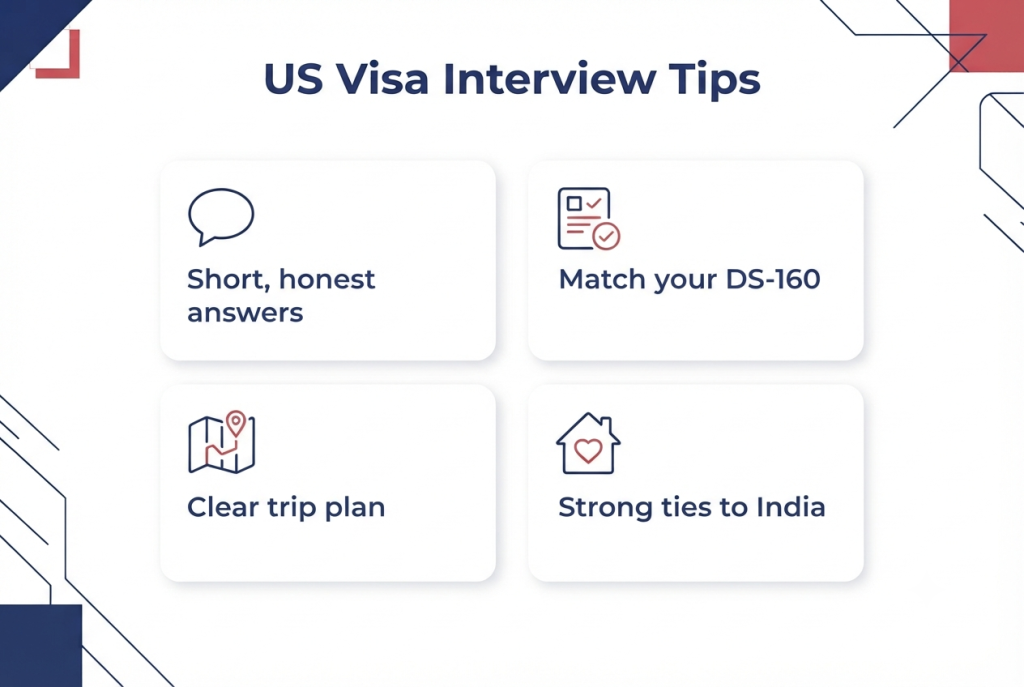
Answer short and true. One or two clear sentences per question. Do not recite a script, and do not offer documents unless the officer asks.
US B1/B2 visa fees and rules from India (2027)
| Item | Approximate amount / note |
|---|---|
| Visa application fee (MRV) | $185 per person |
| Visa integrity fee | A new $250 fee has been announced for many non-immigrant visas; check whether it is being collected when you apply |
| Visa validity for Indians | Often up to 10 years, multiple entry (decided by the officer) |
| Stay per visit | Decided at the US port of entry, often up to 6 months |
| Social media on DS-160 | You must list the social media accounts you used in recent years |
Approximate figures. Fees and rules change often — always confirm on the official US Travel Docs India site or the US Department of State visa page before paying.
For the full process, documents and timelines, see our page on the USA tourist visa from India.
How to improve your US visa chances (step by step)
- Fill the DS-160 yourself, carefully. Every answer must be true and match what you will say in the interview.
- Plan a short, specific trip. Cities, dates, who you travel with. A 2–3 week trip looks natural.
- Build travel history if you can. A Schengen, UK or Southeast Asia trip used correctly makes a real difference for first-time applicants.
- Carry strong documents, even if not asked. Employer letter with leave approval, salary slips, ITR, bank statements, property and business papers.
- If someone sponsors you, carry their letter, income proof and relationship proof.
- Practise speaking, not memorising. Explain your trip to a friend in your own words.
- Be honest about earlier refusals. The officer can see your record. Hiding it is far worse.
- Reapply only after something changes. A new job, more travel, a clearer purpose — not the same file again.
Common mistakes to avoid
- Copying DS-160 answers from someone else. Officers notice when your answers do not fit your life.
- Long, rehearsed answers. They sound fake. Keep it short.
- A vague or very long trip. “6 months to explore” with a full-time job raises doubts.
- Mixing purposes. You cannot work, study full-time or take paid jobs on a B1/B2 visa. Do not hint at it.
- Booking non-refundable flights before the interview.
- Reapplying the next week with no change. Repeated refusals on the same file make things harder.
- Hiding social media accounts or earlier refusals. Incomplete or false answers can lead to refusal or worse.
Refused under 214(b)? What next
A 214(b) refusal means the officer was not convinced of your ties or purpose on that day. It is not a permanent ban. You can reapply, but only when you can show something new: a stronger job situation, more travel, a clearer reason or better evidence. Our Visa Refused? Get Help page explains how to plan a reapplication.
Key takeaways
- Your US B1/B2 visa chances from India depend mostly on a short interview and your ties to India.
- Officers presume you may stay unless you show a genuine short trip and strong reasons to return.
- Most applicants now need an in-person interview in India; book early because waits can be long.
- The visa fee is $185; a new $250 visa integrity fee has been announced — confirm before paying (approximate).
- Short, honest answers that match your DS-160 beat memorised scripts every time.
- A 214(b) refusal is not permanent — reapply only after your situation genuinely changes.
Frequently asked questions
What are my US B1/B2 visa chances from India?
There is no fixed approval rate for a person. Applicants with a stable job or business, filed ITRs, family responsibilities in India, earlier travel and a short, clear trip plan usually have good chances. Weak ties, a vague purpose or answers that do not match the DS-160 lower the odds.
How much bank balance is needed for a US visitor visa from India?
There is no official minimum. The officer wants to see that the trip cost is reasonable for your income and that you can pay without working in the US. Steady savings, salary credits and ITRs matter more than a single large balance.
Is an interview compulsory for a US B1/B2 visa from India?
For most first-time applicants, yes. Since September 2025 the interview waiver has been sharply limited, mainly to some renewals. Check the official US visa site for India to see whether you qualify for a waiver before booking.
What is the US B1/B2 visa fee for Indians in 2027?
The visa application fee is $185 per person. A new $250 visa integrity fee has also been announced for many non-immigrant visas; check the official US visa site for India to see whether it is being collected when you apply (approximate).
Can I reapply after a US visa 214(b) refusal?
Yes, there is no waiting period by law. But reapply only when something has really changed, such as a better job situation, new travel history or stronger evidence of your ties to India. You can check your updated chance on our free visa calculator before paying the fee again.
Before you pay the US visa fee, check your visa chance free in 2 minutes →